Due to the complexity of maintaining multiple blog sites, I decided to consolidate and only blog at my main site WoodSkills. If you want to follow along on my projects and builds, feel free to subscribe at the following link. You will be notified of new blog posts and I will also include blog post links in my newsletter.
Not long ago, woodworking was considered to be in a downward spiral with diminishing followers and practitioners. Pundits were proclaiming the demise of woodworking as a hobby. Fewer young people were taking up woodworking and interest in building their own furniture was waning. Why bother, with so much commercially mass-produced furniture available at reasonable prices. In addition, style trends come and go and being saddled with an out of style furniture piece became an issue. Staying on top of style trends has become instilled in us through the proliferation of interior design and renovation shows on television. Furniture has slowly become a disposable or recyclable object instead of a heirloom piece to be handed off to future generations. When you think about it, this trend flies in the face of environmentalism and celebrates the creation of even more trash. Out of all this doom and gloom rose the maker movement.
This younger generation of makers has slowly begun to appreciate the creation of things with their hands. Increased waste going to landfills brought awareness to the never-ending cycle of consumerism. Let's face it, people are much less likely to throw out something they have created themselves. The virtues of designing and making an object has returned people to their heritage of being self-sufficient, inventive and to not be reliant on industrially produced goods. Through handcrafting, people could imprint their own mark on an object and customize the design to reflect their own aesthetic. The current maker movement is simply an evolution of the arts & crafts movement which has defined creative people for countless decades. The maker movement is an updated form of the craft movement where new materials, technology and ideas are being incorporated into craft.
A spin off of the maker movement has been the return to creating one's own furniture. In fact, a large and growing segment of the maker movement revolves around designing and building furniture. The best part of this is how young people have once again embraced the creation of their own furniture for reasons different than in the past. In the past, the younger consumer could not afford furniture so instead built their own. Today, the reasons for building your own furniture revolve around handcrafting, channeling creativity into a furniture design, and the process of creating an object. It isn't so much about the result but the experience of getting there. Younger makers today are turning furniture design on its ear by shunning age old design constructs and paradigms, and instead embracing a fresh outlook on furniture design.
In the past, bolder and radical furniture designs were the product of reclusive studio furniture makers with limited means of communicating with one another. Today instead, younger makers are informed primarily through social media. Practicality and functionality of design have become the new criteria for furniture design. The furniture of this new generation of makers embraces universality and democratizes design. Social media plays an important part in design today within the maker movement. Through social media, furniture designs have become instantly available to both inform and influence other makers. Through social media, makers can quickly adapt an existing design to their own aesthetic or style. The process of fleshing out designs is considerably accelerated through social media and democratization.
So from what I observe, things are looking up for furniture making and woodworking in general. There is a resurgence occurring in this decades old creative outlet. A new awareness of the virtues and benefits of creating objects using wood as a medium is occurring. I am fairly active on social media and an often awed by radical new furniture designs from this new maker movement. Along with this, the democratization of design will hopefully benefit us all as we can extract elements of shared designs to incorporate into our own work.
A while ago, I created a small cabinet that had been designed to be table-mounted. Over time, the issue was lack of table space causing me to move the small cabinet here and there. It seemed to always be in the way. Of course, it could have been converted to a small jewelry cabinet, but there was no demand for this. A little thought went in to the next life of the cabinet and the idea of mounting it on a dedicated stand came up. So this is what I did. The cabinet itself is not deep and a stand would need to compensate and add depth to the structure. Unless the depth was increased, there would not be sufficient stability.
After some thought, re-visiting earlier designs of mine, and perusing though James Krenov's designs, it came to me. The cabinet would float over the stand allowing me to increase the depth by approximately 1.5 inches. Along with is, I introduced the technique of bird's feet at the bottom. These elongated, arced wood elements extended the depth or form another 2 inches. All told, the new depth was sufficient to make the cabinet on stand stable.
The build also consisted of some modifications to the actual European beech cabinet. New drawer faces, applied contrasting edging and lowering of the base. Cherry was selected for the stand to contrast with the much lighter beech of the cabinet. The cherry stand was built separately. Legs are rift-sawn cherry and the rails are staggered to lighten up the façade and introduce strength and rigidity. Since there are no lower rails in this stand design, the upper, offset rails would need to be mortised into the legs. I also added a contrasting piece of inlay to the upper front rail of the stand to balance the aesthetic. Images below are after the completion of the build and approximately a week later. Cherry has become darker since, as seen in later images.
Over time and with increased use of hand tools, I enjoy creating jigs and tools to make the experience a better one. As a left-handed woodworker, I struggle with tools that are primarily designed for right-handed use. Regular bench planes are not an issue as they are symmetric in nature. When it comes to joinery and specialized hand planes however, the handedness is a little more critical. I have adapted for the most part but in some cases prefer a left-handed version of a tool as it feels more natural to me. In summary, I need to work on both sides of a workbench to accommodate either a left-handed or right-handed tool.
To overcome this, I developed this interesting workholding jig that plugs into the tail vise, in my case a twin screw vise, and serves to extend the operation of the vise over the workbench surface. Twin screw vises or end vises when used as tail vises, introduce a large gap between the moving jaw and the workbench surface. Another consequence is that the workpiece is hanging over the end of the workbench, not an ideal orientation for working with hand planes. The sliding tail vise emulates a real tail vise in its operation. Racking is also eliminated when clamping narrow boards through the four point system.
The sliding tail vise transfers clamping to the main workbench top. Inherent in its design ,it attaches through four points. Two fixed points in the outer jaw and two sliding points within slots. I can now quickly clamp a workpiece to the workbench surface through a wide bearing surface and if necessary lock it in place through two knurled bolts.
The sliding tail vise is also designed to be portable. I can easily use it on either side of my workbenches depending on the tool being used ( left or right hand orientation). I have also updated the design to work better with plow planes and the depth adjuster on this type of hand plane. This can be seen in the last image. So what began as a project to allow me to use the twin-screw vise to clamp on either side of a workbench, has turned out to be a really versatile clamping aid for an end vise or twin-screw vise regardless if you are left or right-handed.
Instructions and CAD diagrams are now available on how to create this sliding tail vise along with detailed plans. The plans are specific to Veritas workbenches, but easily adaptable to similar workbenches with either an end vise or twin screw vise. Plan available through www.woodskills.com
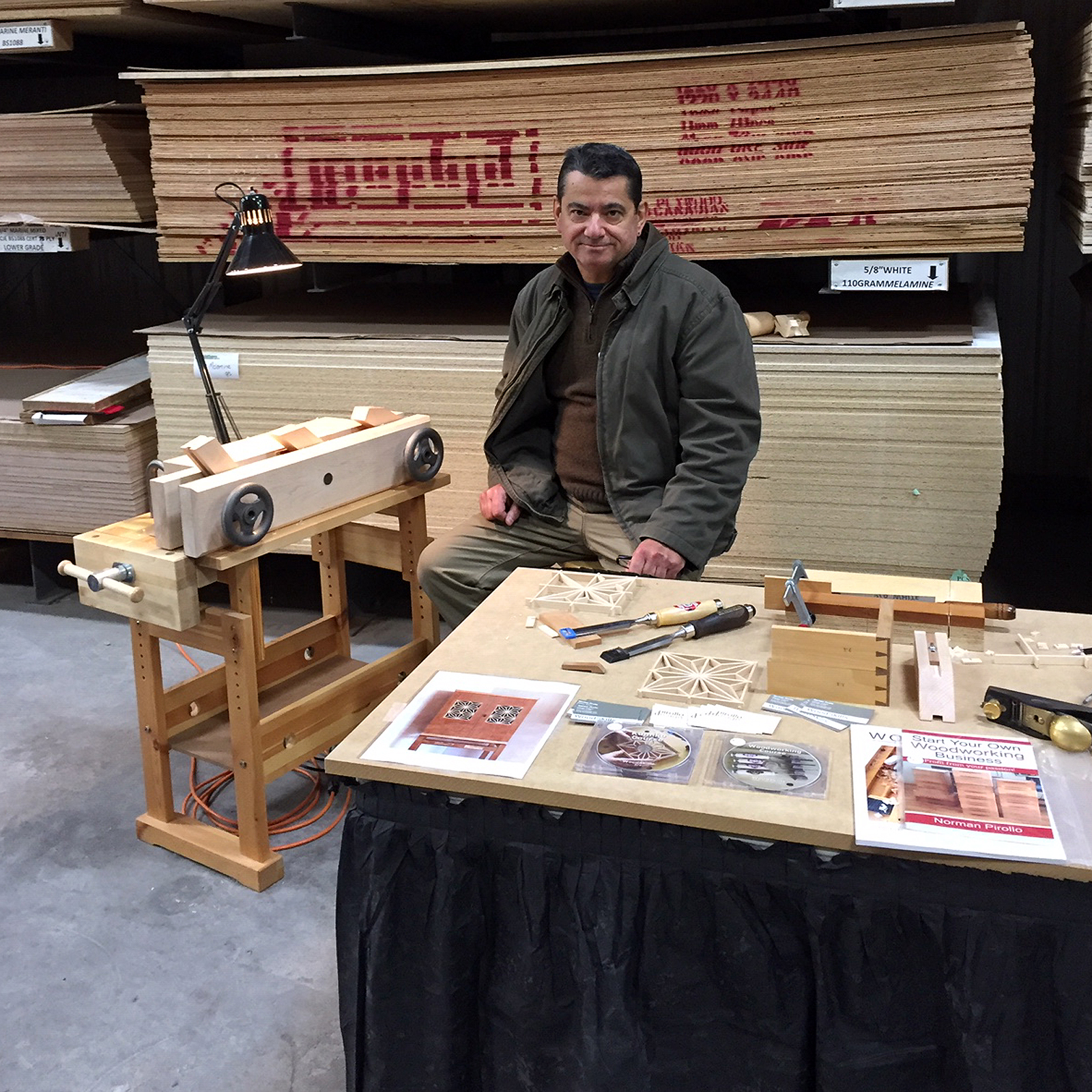
I came across an opportunity to both demonstrate and talk about the traditional Japanese craft of Kumiko at an annual woodworking event. In discussion with a local wood supplier and mill (Wood Source Ottawa, Ont.), they mentioned their upcoming annual open house and how they encouraged local vendors and artisans to participate. I quickly signed up at the opportunity to present and share my passion of Kumiko. Proceeds from the open house silent auction also went to a good cause, so this became another motivation for me to participate. I truly enjoy discussing woodworking and love to engage with people and hopefully motivate them to either start or continue to pursue woodworking.
I had several days to prepare and had sufficient time to create enough Kumiko components to last through the open house. The opportunity also challenged me to devise an innovative way to hold Kumiko guide blocks without having to continually unclamp and clamp the critical guide blocks to a vise. I was able to enlist my Moxon vise along with a small workbench to perform this. The opportunity also provided me the impetus to market a Kumiko Course I had been working on. I could offer the video-based course at the open house! So this all came together and I enjoyed two days at the open house engaging with people and introducing them to the centuries-old traditional Japanese craft of Kumiko.
At first glance, people would be in awe at the small scale of components in Kumiko. Their first reaction was how intimidating and difficult it was to tackle. After engaging and demonstrating the ease of forming and shaping the small interlocking parts, their fears vanished. Often, people need to have a technique presented in a live setting to grasp its intricacies. I get this and can easily relate to this form of learning and visualization. Techniques of safely using a wide chisel to pare wood were also demonstrated, being the core of Kumiko component creation.
I enjoyed the experience and in the process made a few local contacts. Hopefully, I have encouraged a few people to tackle Kumiko and woodworking in general. Working in a solitary studio environment often keeps me from interacting with like-minded people that share a common interest in woodworking. People enjoy sharing their passion and the timing of this open house was ideal since I was between projects and needed a break from my furniture design + making.
I have been immersing myself into the world of Kumiko over the past year. The intricate patterns or motifs draw you in where the possibilities are endless to the application of the panels in furniture. Another interesting fact is how Kumiko is a traditional Japanese form of craft. To be able to recreate the same motifs that were designed centuries ago intrigued me. At first I thought the delicate technique would be difficult to achieve since the scale of the components in Kumiko is quite small. Kumiko can be intimidating to a novice. Upon further research, I decided to further explore and experiment. As a woodworker, I enjoy challenges and this would be yet another in a long string of challenges over the years. How else do we grow as woodworkers if we don't embrace new skills and techniques.
So one thing led to another and after a few early failures and struggles, I was successful at mastering the Kumiko process of creating intricate lattice-like patterns within a grid or frame. The prerequisite to even beginning Kumiko is to create a couple of guide blocks. The blocks have preset bearing surfaces shaped at various angles. These angles are instrumental to the components within a Kumiko grid. Through the judicious application of a chisel to the miniature Kumiko components, precise angles that interlock the pieces are shaped or beveled. The process is methodical but enjoyable. Small or large grids of components can be created, where time and patience are the only variables.
There are several motifs or patterns to choose from, my focus was the asa-no-ha pattern or hemp leaf pattern. Although Kumiko patterns are considerable, nothing stops one from designing their own patterns. The challenge soon was overcome and the process became second nature to me. The next logical step was to integrate Kumiko into a display cabinet. This worked out surprisingly well!
Most recently, I packaged together several instructional video on how to make Kumiko. The videos show the detail involved and how to create the grids from rough blanks. Other videos focus on creating the small parts within the grid forming the intricate patterns. I also realized that creating the guide blocks is a prerequisite to Kumiko and this step kept many people from experimenting with Kumiko. So other videos describe how to create guide blocks in detail (from rough blanks). Guide Block plans are also included in the Kumiko Course.
A gave myself a nice birthday gift the other day. Filed patent with the USPTO on anti-kickback system for tablesaws, so I can disclose it. A project important to me as I have experienced kickback a few times and made it a mission to fully understand it. Addresses table saw safety and the pervasive problem of dangerous and violent table saw kickback. The AKS system actively mitigates kickback. It can electronically sense 3 common kickback conditions and activate a braking system. The project began 3 years ago but I abandoned it due to its complexity. There were insurmountable technical hurdles that involved considerable more research.
This summer I once again embraced the project and pushed through the technical hurdles. The table saw in the video is a purpose-built prototype for testing of and demonstrating the AKS system. There was a huge learning curve to be able to accomplish this, develop the software to control it all, understand motor control and fabricate the prototype. AKS system can be integrated into any new table saw on the market. Best part is it works and exceeds expectations!!
So after a tumultuous month of March, the latest woodworking book is complete and published. Available in digital and print. March began with a bang (literally). My wife and I were broadsided at an intersection causing our SUV to roll and slide down the road for 100 ft. or more. We got out with aches, pains and bruises but on the mend now. The healing time allowed me to focus on this book more heavily and today I am happy to announce it's release! Below is a description for the book.
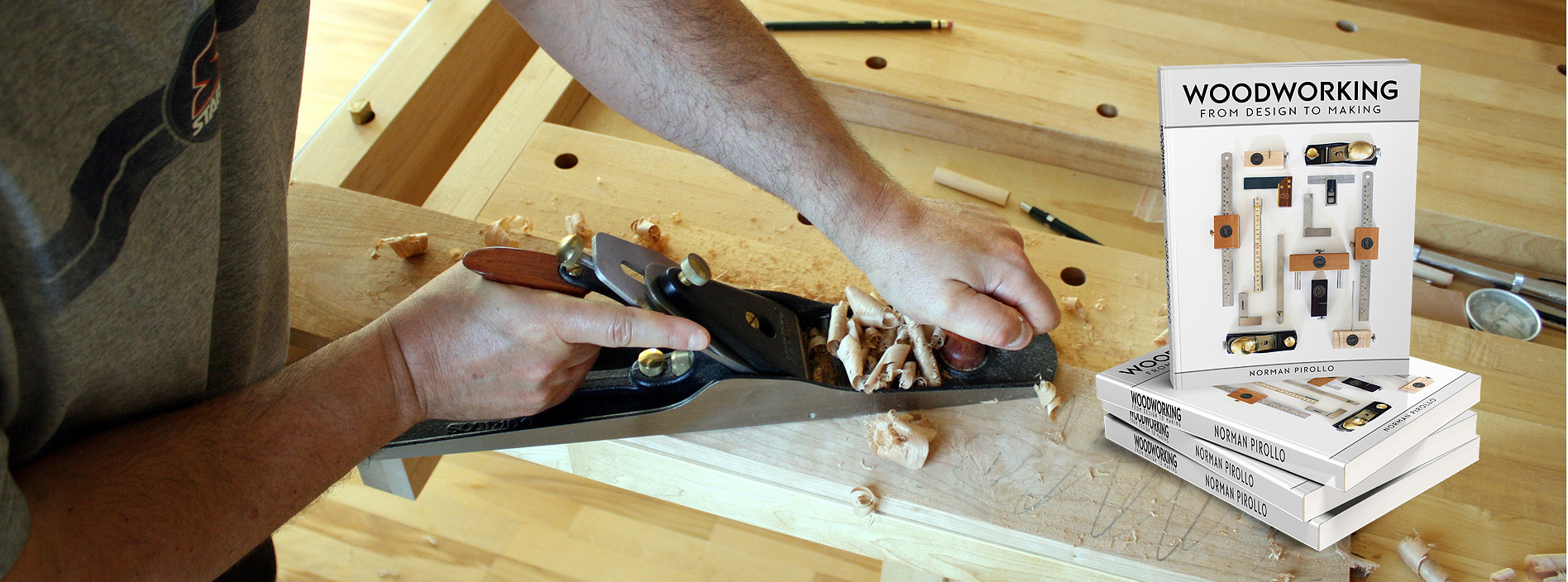
Decades of furniture making experience combine with furniture design in this new and refreshing take on woodworking. In addition to detailed furniture making techniques, the book delves into the thought process behind furniture design. Skills and processes to advance you as a woodworker and furniture maker are described. The book is also a window on the life of a furniture maker. Although the focus of the book is hand tools, use of machines in the preparatory phase of a furniture build is addressed. Time and labor-saving precision hand tool procedures are discussed. The emphasis turns to hand tools in latter stages of a furniture build where attention to detail is necessary. A reverence to wood as a medium is featured throughout the book.
Homage is paid to classic techniques such as dovetail joinery and workbench processes. As well as the traditional, modern techniques and processes are put forward to make your furniture designs stand out and be unique. The focus is one of a kind furniture, the unique furniture and wood objects that separate you from other makers. As a furniture designer + maker, discover my passion, what drives me and where I draw inspiration from. Learn how to develop your own style, aesthetic and voice in furniture design. It is not the how but the why behind the process that is often critical in a furniture maker's mind and practice.
The premise for this book is to provide insight into the craft of woodworking and more specifically the creation of furniture. The book is composed of sections, each of which is critical to your woodworking journey. Acquiring skills and knowledge in the last century involved taking classes, reading books or mentoring with a knowledgeable woodworker. Today, in comparison, there is a wealth of knowledge available through the Internet. What is lacking however, is the hands on aspect of the craft of woodworking. Learning involves making. I know of no one that learned a craft by simply reading and not applying themselves. It is critical to embrace the often lengthy learning curve involved. This book includes several articles focusing on aspects of woodworking in a contemporary world.
The book is composed of four sections. Each section contains articles that a woodworker or furniture maker will need to embrace as they evolve. The first section introduces basic woodworking skills. A large part of this book is devoted to hand tool skills. Although machines are combined with hand tools in my furniture making, I advocate that woodworkers should embrace hand tools. It is necessary to form a connection between hand and wood medium prior to seeking efficiency and a production mindset. Hand tools often get a bad rap as being slow and tedious. Instead, what hand tools offer is control, dexterity, quiet and a close connection to the wood medium. In a one person furniture making studio, hand tools offer a healthy balance to the use of machines. Projects include through dovetails, portable board jack build, moxon vise build, and knife hinge install.
The second or furniture maker section provides a glimpse into furniture making as a career. Woodworkers often aspire to become furniture makers or go into business for themselves. As a furniture maker for several decades, I share knowledge and insight acquired over the years. Some articles will inspire you to take the leap and become a full time furniture maker. Topics in the section include setting up shop, the furniture maker journey, the furniture maker lifestyle, social media for a furniture maker, and insight into diverging from furniture making to other forms of woodworking.
The third section is devoted to furniture design. Furniture design forms a large part of woodworking. Often, it is necessary to design a complete piece of furniture or modify an existing design. The design process has evolved over past decades with the advent of computer software (CAD). Pencil and paper are now combined with CAD. Articles include how to create and refine a design, the concept of form and function and how it applies to furniture.
The fourth or advanced woodworking section delves into techniques to further your woodworking and furniture making. Veneering techniques, both manual and vacuum veneering are described. The process of creating a jewelry box is discussed in one article. The Japanese art of Kumiko is described in a final article.
After exploring Japanese Kumiko and in particular the asa-no-ha pattern or motif, I created a few panels. I also took it one step forward and framed the panels with pieces of cherry or mahogany I had lying around. The asa-no-ha pattern below seems to be the most popular and it can be seen reproduced by several woodworkers.
Having mastered the Kumiko process for the asa-no-ha pattern and in the process created several panels, I soon realized that they should be applied to a project. Kumiko panels on their own are only decorative, they are really meant to be incorporated into furniture, shoji screens, etc.
Without a new project in mind and after some brainstorming with my wife, the idea was hatched to integrate one of the larger Kumiko panels into an existing piece of furniture. While discussing, my latest Krenov display cabinet was directly in front of us. Hey, why not experiment with the Kumiko panel on this cabinet. So a cardboard mockup of one door was created and a large Kumiko panel carefully fitted in to be able to view the inside of the cabinet.
After some discussion, we both agreed that the idea was worthy of further exploration. I also secretly wanted an excuse to create more Kumiko panels and become better at it and to develop techniques. Next, two matching Kumiko panels were created and framed with cherry pieces. It was also decided to create the doors out of cherry. Selecting the wood for the doors was not an easy one. Lately, I have been making an effort to draw down my existing inventory of wood. I have so much existing inventory and it doesn't make sense to keep purchasing more wood. The only issue was the grain orientation of the wood. Since these are doors with about 9 inches in width, I preferred quarter-saw or at the least rift-sawn for dimensional stability. After exhaustively searching my pile and deliberating, a single cherry plank appeared to meet the criteria... for the most part. I also wanted a wood that would have the lighter Kumiko panels stand out. Cherry normally darkens with age and exposure to light, so this was an critical consideration. The cherry plank was selected since it was light pink or brown and was not likely to turn a deep red. I preferred a medium colored brown as the final color, to match the cabinet stand and interior drawer fronts. With cherry, the final color is often a crap shoot. So cherry it was for the doors.
The cherry plank was sawn and laid out for the door components. Doors assembled with an opening for the Kumiko panels. Kumiko panels were fitted in and temporarily attached as seen directly below. All is good at this point, the Kumiko panels fit like a glove. Door components were selected and laid out to minimize any horizontal movement across their width.
Proceeded to then create a lip and rabbet where the doors meet and to permanently install the Kumiko panels. It was absolutely necessary for the new doors to perfectly match the original doors in both width, length and thickness. This was due to the knife hinges used and the close tolerances necessary for their operation. The door reveals were also an important criteria. In other word, the new doors would need to be dimensionally exact as the original doors.
The photos above show the progression in both dimensioning the doors to size and creating the lip and rabbet where they meet. The last photos below have both doors installed in the cabinet prior to application of a shellac finish. The single right cocobolo door pull is also prepared and fitted but will only be installed as a last step. A temporary basswood filler piece is inserted in the mortise for the door pull. From previous experience, a protruding door pull seriously gets in the way of applying a French Polish type of finish.
Follow me on Instagram for progress updates: Instagram: @woodskillsmag and @pirollodesign
Apologies for not posting more regularly but most of my project builds and images have moved to Instagram, @woodskillsmag and @pirollodesign. I've been working on my latest piece for a few weeks now. It is a cabinet on stand inspired by James Krenov work and philosophy. The story behind this particular piece is as follows. I originally created a similar piece to this in early 2012 and looked forward to making another a few months later.
Original cabinet on stand designed and created in 2012. Door and side panels are veneered with figured Big Leaf maple, interior is soft maple, back panels are Ambrosia maple, stand is cherry.
The design adheres to the principles of Krenov, construction follows his methods and philosophy, and the aesthetic is clean, minimalist and devoid of ornamentation. This has also become my furniture making style in the past 14 years or so. I discovered the work of James Krenov about 14 years ago and read his books quite regularly, each time extracting a new nuance or so. This was the age when learning from woodworking books was the preferred way of understanding woodworking. I followed Krenov's writing and tried to glean as much technical information from the grainy black and white photos in several of his books. A little while later, I attended a furniture making school that was founded on the principles of James Krenov and College of the Redwoods. It was one of a very few schools in North America espousing the tradition of hand work. This experience opened my eyes to a slower form of furniture making where the focus is on the wood itself and attention to detail is paramount. Where am I going with this? Well, between the years 2012 and 2018 I pursued a few other interests, mainly wood sculpture, furniture design, video production, writing books and publishing a semi-annual woodworking magazine WOODSKILLS. As well as returning to school to follow a one year business program, my woodworking continued.
My woodworking (2012-2018) followed a different path where I embraced modern, contemporary design. In this intervening period, I entered furniture design shows with very contemporary console table and chair designs. The years went by while I yearned to revisit that original cabinet on stand and hopefully make another. I had even developed a set of plans and drawings of the cabinet at the time thinking it would be a matter of a few weeks before I could start on another. Fast forward to late 2018 and I finally set aside time to fulfill this build. The following are progress shots. This version of the cabinet on stand has a slightly modified interior layout than the original. The stand is configured differently only because it was possible to do so and I wanted it to be both different and unique. A couple of new additions are a hidden, secret compartment, inlay on the front apron of the stand and the cabinet floats on the stand. Otherwise, the design follows the original piece created back in 2012.
Installing knife hinges in 2018 version of cabinet on stand
Fitting door panels an creating lip and rabbet where they join.
Interior layout of new cabinet mocked up on cabinet base (using a few of the tools I design + make).
Cabinet mocked up and drawer fronts fitted. Hidden compartment also visible below right-hand drawer compartment.
New set of three dovetailed drawers created (at bottom).
New dovetailed drawers fitted into respective drawer compartments.
The legs, aprons, rails for stand are mortised and prepared for loose tenon and dowel joinery (using modified horizontal mortiser).
Progress checklist (whiteboard and dry erase markers) on one of two wall-mounted hand tool cabinets.
Creating mortises for drawer and door pulls ( cocobolo heartwood and sapwood combination)
French Polish process for door panels and cabinet sides.
New version of cabinet completed. Note the dropped front apron with inlay and floating cabinet on side rails.
Cabinet with figured Big Leaf maple door and side panels and cocobolo pull. Cherry stand with inlay.
Interior of 2018 cabinet. Compartments are flipped from 2012 cabinet. Secret compartment behind the small blue cup at lower right.
The new cabinet on stand seen here. Final detail was the addition of a single, small bullet catch at top of right-hand door.
So I've fulfilled my requirement of building a Krenov-inspired piece of furniture every six years or so 👊😉
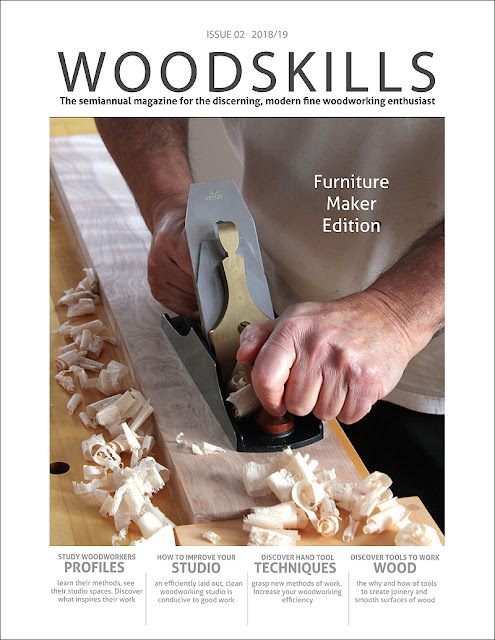
The idea was hatched a year or so ago. A new magazine catering to the discerning, fine woodworking enthusiast. It was an idea that slowly developed and at one point became a reality. So a small team and I have been working at this and are happy to announce that the latest issue of WOODSKILLS woodworking and furniture making magazine is now available. Some of the features in this Furniture Maker Edition include furniture maker articles, profiles of accomplished furniture makers, best studio practices, contemporary furniture design, gallery, vacuum veneering, Moxon vise build, sharpening + woodworking strategies, wood selection strategies and social media for furniture makers. The terms studio and workshop are used interchangeably throughout the magazine. WOODSKILLS is a semi-annual publication, published twice yearly in late spring and fall.
As a follower and practitioner of James Krenov style of work and methodology, both hand tool and some machine techniques are included. Although the vast majority of articles refer to hand tools, machinery is not excluded. I find this to be a more realistic approach in this day and age. Machines can do the grunt work whereas hand tools are used to create joinery, shape and finesse furniture components, smoothing surfaces, etc. Advertising is at an absolute minimum and consists of curated advertising, a term gleaned from the art world. Advertising must reflect practices and products that our readers and the team at WOODSKILLS could use or include in their own workshops and studios. Available through woodskills.com (digital) or Amazon (print version) or Blurb (premium print version).
Furniture Designer + Maker Profiles
Darrell Peart, Craig Thibodeau, Jan Lennon, Brian Greene
As a few of you may know, my woodworking and furniture making career is the second one of my life. A long, first career in the hi-tech industry preceded my current career. It is difficult to view life through a rear-view mirror but I often think of how it would have been if the leap had been taken earlier on. When I began in hi-tech, technology was rapidly advancing and I could not absorb enough of it. My life revolved around computer technology and software. I worked for possibly the best multi-national computer firms and there was a mutual respect of what we brought to each other. Hi-tech today is quite likely the same where change is fast and furious. However, sometime in the middle of the hi-tech career I began to realize that grasping the latest technology was becoming a full-time job. It became increasingly difficult to keep up with the latest in hardware and software. I shrugged this off and continued on the journey, after all I did need a career and a pay cheque. My performance was above par but it became obvious I could not keep the façade going for several more years. The technology was just not as exciting to me anymore. I felt something was lacking in my life and began to seek a creative outlet instead.
A short time later I discovered woodworking through an evening class and was smitten. The creative aspect of woodworking and making tangible objects with the hands was the part lacking in my life. My focus began to turn to woodworking and the hi-tech career simply devolved into a series of jobs. One thing led to another, I launched a small part-time woodworking business over 20 years ago, it grew but not enough for me to leave hi-tech. The struggle of juggling employment with the part-time business eventually took its toll. I retreated and told myself the next step was to become a full-time woodworker. Life gets in the way however! A marriage, new home, a couple of downsizings later and I could finally live the dream of having my own furniture making business.
I often ask myself if I remained in the hi-tech industry for perhaps ten years too long. Looking back, I should have possibly exited hi-tech, struggled at woodworking and not look back. The hi-tech employment became a crutch and it was the pay cheque that kept me from leaving. It is difficult to say what the best path would have been. Circumstances were different in my case, it has all worked out in the end, but the "what if" lingers! Today, I see many younger woodworkers taking the leap into full-time woodworking and commend their courage. After all, why pursue a career you no longer have an interest in. This is one of life's biggest lessons and as mentioned earlier it is difficult to look back through a rear-view mirror. I recently read an article that summarized people's biggest regrets later in life. The regret of not having pursued their dream was high on the list. To summarize, pursue your passion!
So I teamed up with a videographer and created the following video in the form of a 5 minute synopsis of my exciting second career in woodworking and specifically furniture making!